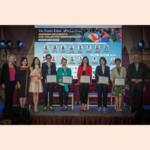
London, United Kingdom — Filipino-British artificial intelligence strategist Edward Morris is exploring strategic expansion into Southeast Asia following the development of advanced enterprise AI systems across Europe and recent participation in convenings aligned with the 80th Anniversary of the United Nations General Assembly.
The anniversary marked eight decades of global governance and brought together policymakers, diplomats, institutional leaders, and technology stakeholders at a moment when artificial intelligence is increasingly shaping economic and geopolitical power. Morris’ participation reflects the growing intersection between enterprise AI architecture, digital governance, and international policy dialogue.
His involvement follows international recognition of his work in enterprise artificial intelligence, with features and commentary in Financial Times, Forbes, and The Times.
Across Europe, Morris has designed structured multi-agent AI systems for organisations navigating generative AI adoption at scale. These architectures support executive-level strategy modelling, communications risk analysis, crisis simulation, and automation of complex workflows traditionally managed by specialist teams. His work focuses on institutional deployment, governance frameworks, and operational resilience rather than consumer-facing AI tools.
In parallel with corporate advisory work, Morris has collaborated with departments within the Ukrainian Government during the ongoing war, contributing expertise at the intersection of communications strategy, legal frameworks, and emerging AI systems in high-pressure environments. The experience placed enterprise AI implementation within a context where digital infrastructure and information integrity carry national significance.
The economic backdrop underscores the urgency of this transition. Goldman Sachs estimates generative AI could impact up to 300 million full-time jobs globally. McKinsey projects AI could contribute up to 4.4 trillion dollars annually to the world economy. Since 2023, large organisations have accelerated adoption of AI copilots and workflow automation systems as core operational tools.
Against this landscape, Morris is evaluating opportunities in Southeast Asia, with the Philippines positioned as a strategic focal point.
A Strategic Inflection Point for the Philippines
The Philippines’ business process outsourcing sector generates more than 30 billion dollars annually and employs over 1.3 million professionals. It remains one of the largest English-speaking workforces in the world. However, international studies from the International Monetary Fund and World Economic Forum indicate that repetitive knowledge-based roles face increasing exposure to AI-driven augmentation and automation.
Morris believes this represents both risk and opportunity.
“The Philippines cannot remain comfortable being the world’s assistant in the AI era,” Morris said. “We already operate global systems. The next step is designing and governing them. If we transition from task execution to AI orchestration, we elevate our competitive position rather than defend it.”
Exploratory discussions surrounding Southeast Asia expansion are expected to focus on executive-level AI governance frameworks, enterprise Copilot and multi-agent deployment strategies, and structured upskilling initiatives designed to move professionals from execution roles to AI system architecture and oversight.
Born in the Philippines and later raised in the United Kingdom after a childhood marked by financial hardship, Morris has previously described spending much of his early years in coastal communities with limited resources. His trajectory since then has spanned enterprise AI system design, wartime institutional collaboration, and participation in global policy-aligned convenings.
“Artificial intelligence will redefine economic influence in this century,” Morris said. “Countries that design and govern intelligent systems will shape the next global order. Those that hesitate will operate within systems built elsewhere.”
If formalised, the Southeast Asia expansion would signal an effort to reposition Filipino talent from operational support within global value chains to strategic architects within the emerging AI economy.